“Where Horses Live
The Romantic Winds Crossing Tokara
Tokara Horses on Nakanoshima, Toshima Village, Kagoshima Prefecture (Tokara Islands)”
I encourage readers to compare this article with my book Japanese Native Horses: Past, Present, and Future (sold out as of the end of May).
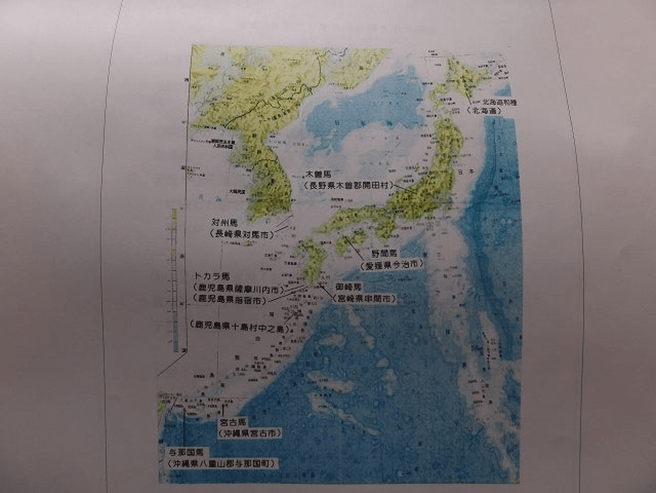
The Tokara Horse
The history of the Tokara horse traces back to around 1902 (Meiji 35), when small native horses were introduced from Kikaijima Island in the former Ōshima District of Kagoshima Prefecture to Takarajima Island in Toshima Village. Because these horses lived on remote southern islands, their bloodlines remained unmixed with other breeds for more than fifty years, surviving in relative obscurity. They were later named “Tokara horses” after the Tokara Archipelago. In July 1953, forty-three horses were confirmed, and in the same year, Kagoshima Prefecture designated them a Natural Monument and began protective measures.
At present, Tokara horses are kept in the following three locations, each maintaining a distinct ecological system.
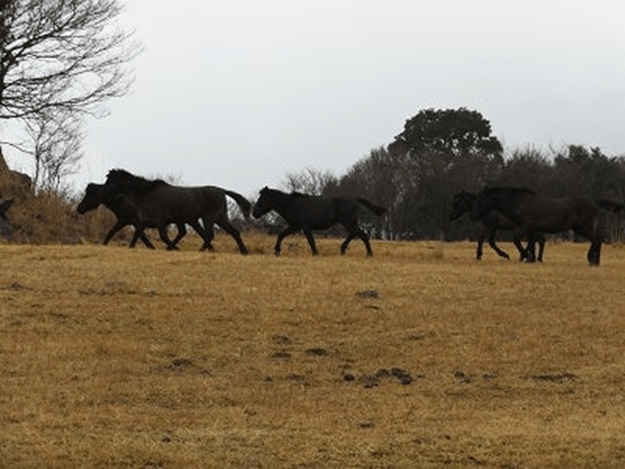
1. Iriki Farm, Kagoshima University (Feral Horses)
This farm primarily exists to study cattle. Horses are kept for the purpose of preserving animal genetic resources and managing pastureland. Human intervention occurs only during testing for equine infectious anemia. The horses are fed only on pasture grass left uneaten by cattle, and no processed feed is given. They form groups of five to six. When the author accompanied the farm manager by car to take photographs, the horses sensed human presence and fled all at once. Even when staff attempted to drive them back, they escaped at remarkable speed. These are truly feral horses.
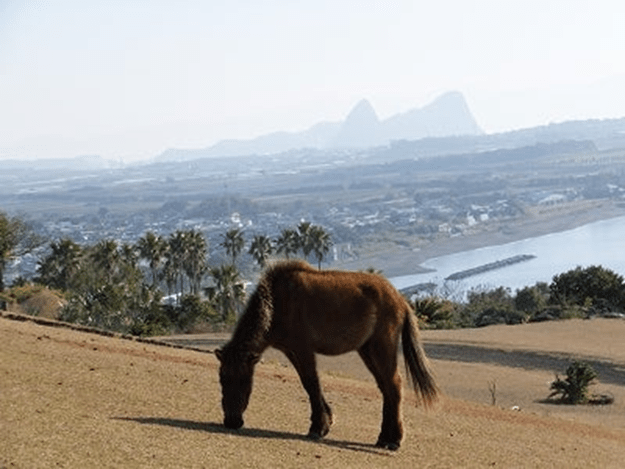
2. Kaimondake Foothills Nature Park (Semi-Feral Horses)
The horses grazing on the gentle slopes show no wariness toward humans, focusing entirely on eating grass and remaining unmoved even when cameras are pointed at them. They form four groups, along with several solitary stallions, but no harems are formed. From 5:00 p.m. to 8:00 a.m., they are enclosed within fenced areas. Pasture grass alone is insufficient, and processed feed costing several million yen annually is required.
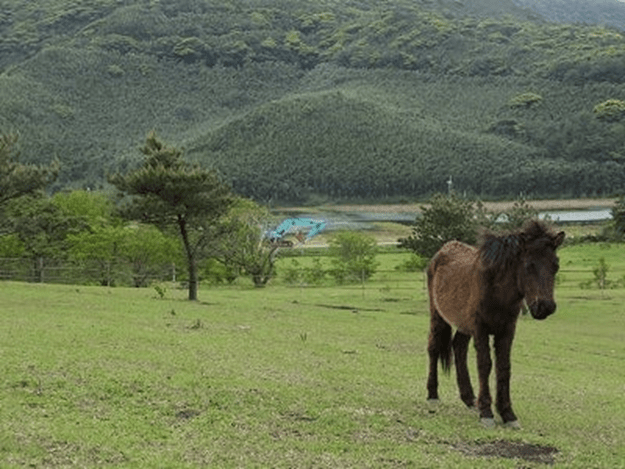
3. Nakanoshima Island, Toshima Village (Feral Horses)
I traveled to a pasture located at an elevation of 250 meters. Reaching Nakanoshima requires a nine-hour ferry ride from Kagoshima Port aboard the Toshima Maru. After a short walk from the port, I rested at a natural hot spring, then walked approximately 2.3 kilometers uphill. What surprised me upon reaching the top was that the area about one meter below the road on the right (the lower pasture) formed a pond, continuing into wetlands and grazing land where eight mares were kept. On the left (the upper pasture), Mount Ontake rises to 979 meters, with forest-lined grazing land housing twelve stallions. The horses were friendly and approached whenever a camera was raised; some even rubbed their heads against people. Unfortunately, during heavy rain, water flowing down from Mount Ontake turns the upper pasture into a river, flooding the lower pasture. Veterinarians visiting to conduct equine infectious anemia testing have pointed out deterioration of the horses’ hooves as a result. While processed feed is provided in addition to pasture grass, the horses appear slightly thinner compared to those at Kaimondake Nature Park, which is concerning.
There is a discussion of relocating one confirmed pregnant mare to Kikaijima Island.
Notes
- Tokara horses are designated Natural Monuments of Kagoshima Prefecture. Ownership is held by the following entities:
- Kagoshima University
- Iwasaki Group Co., Ltd.
- Toshima Village
- In December 2017, hair loss was observed in a pregnant Tokara horse on Nakanoshima, prompting caretaker Mr. Honda to request an investigation by the author. He explained that in February 2015, during a particularly cold winter with snowfall, a one-year-old mare exhibited hair loss that did not spread to other horses but progressively worsened. After reporting the situation to the Toshima Village Office and consulting twice with a professor at Kagoshima University’s Faculty of Veterinary Medicine, no action was taken. The horse lost all hair within about a month and died, with the cause recorded as unknown. In the 2017 case, the village office responded in the same manner, and the professor could not be contacted due to relocation.
The author immediately consulted a veterinarian from the Japanese Society of Equine Science, who stated that despite more than twenty years of work with the Japan Racing Association, he had never seen or heard of such a case and recommended immediate examination and blood testing.
The author first reported the facts to Professor O of Kagoshima University, head of the Tokara Horse Preservation Society (specialist in avian ecology). However, as it became clear that the professor was unaware of the three distinct Tokara horse populations, the author requested that the preservation society formally record the incident. Subsequently, the author reported all details to the Natural Monuments Division of the Kagoshima Prefectural Board of Education. They promptly contacted the Toshima Village Office and initiated a field investigation.
As a result, village officials conducted a serious examination and determined that mites were the cause. After changing the feed and monitoring the horse, winter hair began growing back in mid-January 2018, and the horse regained vitality, as reported on February 7. At the same time, the author was informed by email that future abnormalities should be reported directly to the Board of Education, that Mr. Honda’s three-year contract had been renewed without issue, and that an increase in feed budget had been approved.
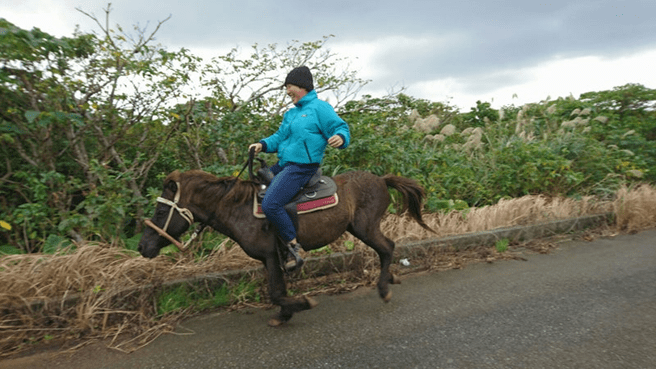
- Mr. Fukutaro Inoue, Representative of Kumejima Horse Ranch on Kumejima Island, Okinawa Prefecture, is the only individual who operates Tokara horses as riding horses. He received one mare on loan from Kagoshima University seven years ago and stated that training took three years. There is no rider weight limit.
September 15, 2019
Sumio Suzuki
 Heheen
コメントを残す